





Due to the growing number of foreigners working in Poland and the intensification of international economic cooperation, the translation of Polish tax forms into English is needed more and more often. PIT or CIT forms, which are basic tools for settling income tax, require a special approach during translation due to their specialized nature.
Translating such tax documents differs significantly from translating business or literary texts. It requires not only excellent knowledge of the source and target languages, but above all, a deep understanding of the Polish tax system and the ability to precisely convey its specificity in the target language. It is crucial to understand that the form remains a Polish document, subject only to Polish tax law, regardless of the language of translation. The translated document will only be of reference nature and will serve as a communication tool that will make it easier for offices, banks and other interested parties abroad to interpret the income and taxes of entities settling in Poland.
Main challenges in translating PIT forms
The biggest challenge is legal and tax terminology, as many Polish terms and phrases have no direct functional equivalents in English. The translator must find a balance between literal translation and maintaining comprehensibility for the English-speaking recipient.
An example of a particularly problematic phrase is “lump sum from recorded income”, which has its own unique features in the Polish legal system, difficult to render in other languages. The term “lump sum” can generally be understood as a predetermined sum of income and turnover tax. However, in the sense of the PIT-28 form, we are not dealing with such an amount, but rather it is a tax calculated at a selected rate depending on the type of income, and you may be subject to even several different rates at the same time. Additionally, it is calculated based on revenue, not income. Often the word “lump sum” is normally translated into English as flat-fee lub flat-rate tax. Here, however, it would be misleading, because flat tax it is a flat tax calculated on the basis of income, not revenue. There is no perfect solution, but you can take suggestions from the existing literature. There is a deadline lump-sum tax and although it is not ideal, because it may suggest one large, predetermined amount regardless of income, it has been accepted in official government sources and in some international corporations. Fortunately, the nature of the taxes in question is usually easy to understand thanks to the context of the form in question.
Another serious challenge poses dynamics of changes in regulations. It is no secret that Polish tax law changes frequently. Annual form modifications are a reality that all form translators must face. Each tax year brings changes in the layout of forms, field numbering, and changes in content resulting from the need to adapt the document to new regulations. From the translator’s perspective, this means the need to constantly monitor the publications of the Ministry of Finance, analyze each new version of the form and compare it with previous versions.
There is also a problem when translating many different forms maintaining terminological consistency. stronghis can be tackled by creating and maintaining comprehensive glossaries, but this is not an easy task. The problem of inconsistency can lead to serious misunderstandings when the same legal term is translated differently in different forms.
Looking at the translation of tax documents from a slightly different perspective, more technical challenges can be seen, strongncluding problems with OCR and graphics system. Polish tax forms are often very complicated in terms of the so-called layout – contain numerous tables with an extremely complex layout, fields to fill in, and special formatting. Their precise reproduction in translation requires advanced technical and graphic skills, often going beyond the standard set of translators’ competences, and attempts to recreate them manually by hand quickly lead to frustration.
Remedies for translation headaches when working with tax documents
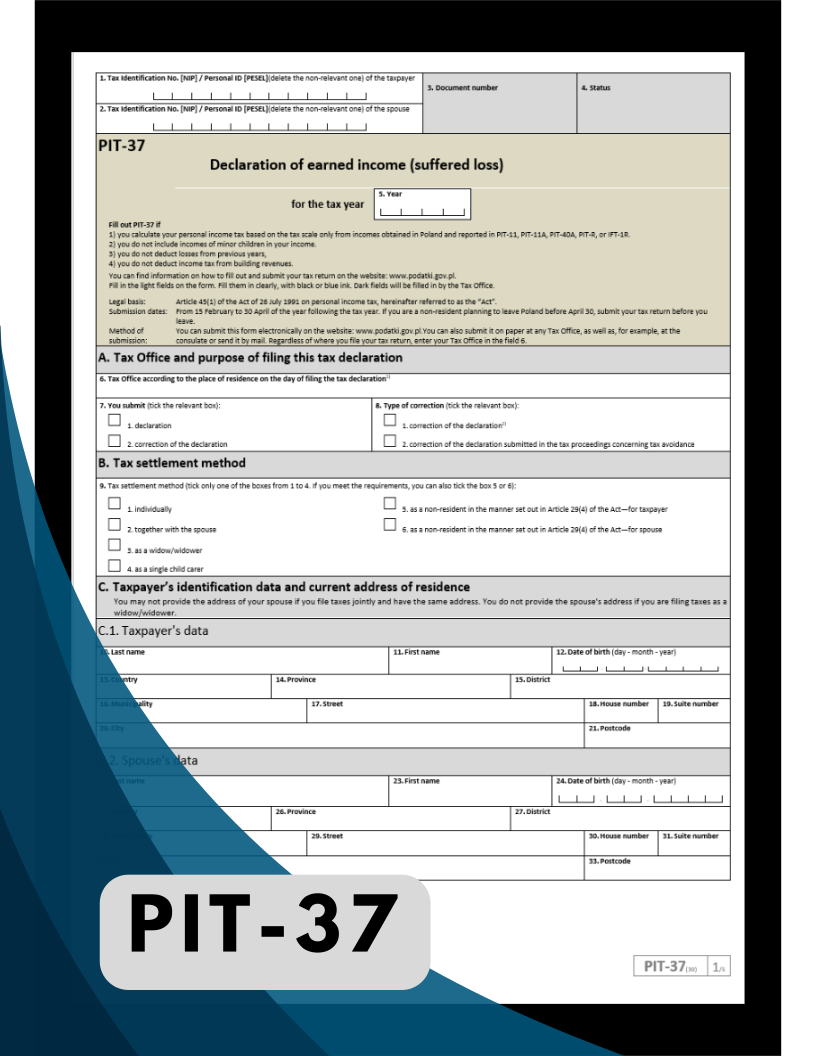
Sample PIT-37 form in English offered by TaxFormLab
Developing effective solutions to problems that arise during translations of Polish tax forms is crucial not only to ensure substantive correctness, but also to maintain the readability and functionality of these documents in the English version. Proposed solutions to the most important challenges identified are presented below.
To ensure terminological uniformity, it should be created and regularly updated glossary of specialized tax terms, based on official translations and konsultacjach with experts. This will avoid discrepancies in translations and help maintain consistency across different versions of documents.
Precise reproduction of the form layout requires application advanced OCR tools, which are good at recognizing tables and complex graphic structures. To use them effectively, it is worth considering participating in odpowiednim szkoleniu. Another good, although ultimately more expensive, idea would be to outsource this type of service external specialists. They will provide us with high-quality, editable files that will constitute a solid basis for further translation and work in CAT tools. Both solutions, however, will require some financial outlays lub czasu. Not every translator wants to devote time to graphic work.
In the context of frequent changes in regulations and the layout of forms the obvious solution is to use CAT tools. Although it might seem that in the era of machine translation and cooperation with artificial intelligence, all translators are already well acquainted with CAT tools, it turns out that quite a large group of people in the industry still function without the support of tools such as Trados or MemoQ. CAT programs prove invaluable in quickly identifying places that require corrections and updates in translations. However, effective use of the tools mentioned is possible only after prior solution problems with OCR i uzyskaniu well-formatted, editable documents.
Taxformlab.com, or how to get rid of all your problems with one click of the mouse
Taxformlab.com gives quick access to current, professionally translated tax forms for each year, eliminating the need to track changes and compare versions. Effective management ensures terminological consistency and stylistic uniformity all forms. Ready-made templates contain a correctly reproduced layout, which helps avoid formatting problems, shortens work time and minimizes the risk of technical errors. Once you have purchased the form, you can use repeatedly, which reduces costs and allows us to offer customers faster implementation and high quality services.
Wnioski
To sum up, translation of Polish PIT forms into English This is a specialized task requiring not only fluent knowledge of the language, but above all, a deep understanding of Polish tax law and the specificity of official documents. The key challenges are the lack of clear ones terminological equivalents, frequent changes in regulations and form layouts and difficulties techniczne associated with formatowaniem i OCR. The use of ready-made, professional templates, translation memories and glossaries significantly increases quality, shortens work time and minimizes the risk of errors. For translators and translation agencies, this means the ability to provide services faster, cheaper and at a higher level, which translates into better service for international clients and increased competitiveness on the market.
In short:
It is worth investing in CAT tools and ready-made templates that ensure terminological consistency and save time.
Developing technical competences, e.g. through training in the use of advanced OCR programs, is necessary for effective work with documents with complex layouts.
Regularly monitoring changes in regulations and using updated reference resources helps avoid errors and ensure compliance with applicable law.
For people who want to deepen their knowledge or expand their skills in the field of tax and legal translations, the following sources and reading are recommended:
Roman Koziarkiewicz, “Dictionary of Tax Terms English-Polish Polish-English” – an extensive source of tax terminology, containing over 5,000 expressions and phrases used in business activities in Poland and on the European market.
Glosariusze PT TEPIS – e.g. a glossary prepared by Tomasz Borkowski, presenting unified legal terminology and official English equivalents used in legal translations.
Serwis Gofin.pl – practical articles and guides on obligations in the tax context, official interpretations, news and tools that may be useful for translators of tax documents.